EXOSHELL Exosphere – Smart Connected Cities
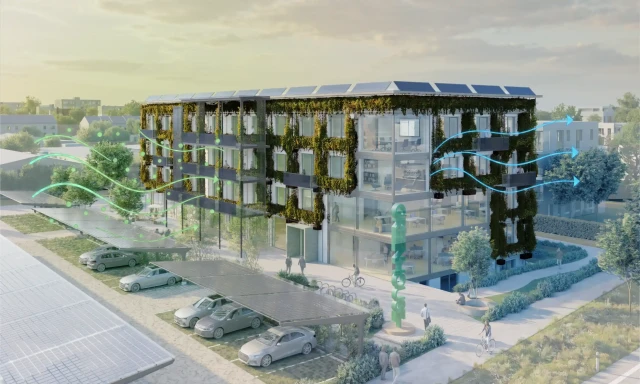
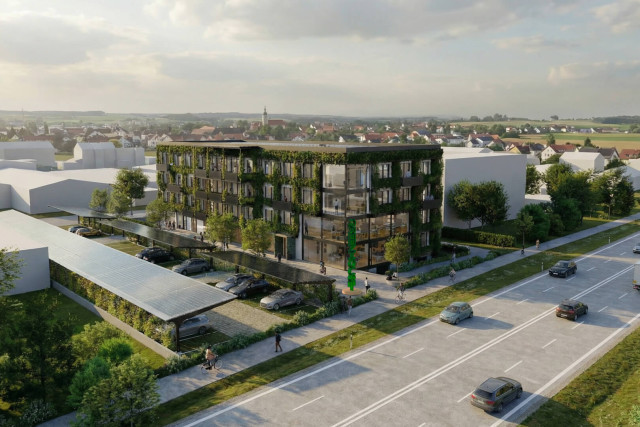
When EXOSHELL transforms not just individual buildings but entire blocks, it gives rise to Exosphere: a connected, climate-active system that measurably cools neighborhoods, generates energy, and provides hyperlocal data to support better decision-making.
Exosphere marks the transition from a building-level solution to urban transformation—modular, scalable, and data-driven. The system’s high sensor and data density is what makes it so unique, enabling cities for the first time to precisely control measures rather than merely reacting to individual events.
When Entire Neighborhoods Benefit
Cities face a multitude of parallel challenges: energy targets are not being met, neighborhoods are overheating, air quality is declining, and available land is dwindling. At the same time, there is a lack of reliable data to effectively manage climate adaptation—decisions are often based on assumptions rather than evidence.
EXOSHELL Exosphere addresses precisely this issue by combining energy, climate, space, and data into an integrated solution for smart cities that does not view these challenges in isolation.
- Real-time data from all facade modules
- Integration into urban control systems
- Foundation for research partners
- Continuous optimization of irrigation, energy, and greening
Understanding and Highlighting the Impact on the Climate
For the first time, Exosphere makes it possible to measure how temperature, air quality, and water patterns change within a neighborhood. Thanks to hyperlocal, smartly connected real-time data, municipal decision-makers can clearly see where measures are having an effect—and where adjustments are needed.
Reduce Risks and Improve Operations
Integrated greening, stormwater retention, and energy generation reduce overheating, mitigate the impact of heavy rainfall, and stabilize the energy supply. At the same time, the quality of the environment improves, and buildings gain functional, economically usable space.
Holistic Effect
Exosphere combines environmental, energy, and spatial solutions into an effective integrated system. With each module, the cumulative impact on the neighborhood grows—supported by clear data for urban planning.
Neighborhoods in Transition – The Effects of Interconnected Facades
UHI Mitigation (Urban Heat Island)
Thanks to extensive greening and coordinated evaporation management of the facade modules, temperatures in the neighborhood drop measurably. Heat islands are mitigated, and street spaces cool down—particularly relevant for densely built-up, heavily impervious urban areas.
Hyperlocal Weather Data
Each facade provides precise real-time data on temperature, humidity, and particulate matter—directly at street level. The data accuracy far exceeds that of conventional urban weather stations and, for the first time, enables high-resolution climate monitoring within individual neighborhoods.
Climate Adaptation Tracking
The effectiveness of climate adaptation measures can be continuously measured and visualized. This provides cities and municipalities with a reliable basis for decision-making regarding which measures are effective and where further action is needed.
Sponge City Interface (Sponge City)
The retention modules of multiple buildings can be networked to collectively manage heavy rainfall events. Water is stored and released gradually, thereby significantly reducing the load on the sewer system. The facade modules function as decentralized storage units within a larger system.
Digital Urban Twin (DUT)
All facade data is fed into a digital model of the city. This enables precise simulations of airflow, heat buildup, and climate-related effects. Cities can not only view current conditions but also simulate scenarios and optimization strategies.
Climate Refuge Zones
Specially equipped public spaces—supported by the climatic effects of the facades—create areas with noticeably lower ambient temperatures. Particularly vulnerable population groups (children, the elderly, and people with chronic illnesses) benefit from safe places to stay during heat waves.
Thinking Beyond the Exosphere
Together, we turn buildings into systems—and neighborhoods into solutions.